Our Values & Guidelines

At the heart of our community, we believe in creating spaces that are respectful, inclusive, and grounded in care. This section outlines the values and principles that guide our work. Here, you’ll find our community guidelines, code of conduct, and the reasons behind some of our choices, such as prioritizing BIPOC participation. Together, these commitments define how we build and sustain a safe, supportive, and respectful community.

Community Guidelines & Code of Conduct

1. Who We Welcome

Our spaces are open to:

Everyone who has, had, or will have a menstrual cycle.

Trans, non-binary, and gender-fluid people, as well as their allies.

All people committed to inclusive, respectful, and compassionate engagement.

We center the experiences and voices of Black, Indigenous, and People of Color (BIPoC), acknowledging their historical and ongoing exclusion from conversations and research about menstrual and reproductive health. If you want to read more about this, click here.

Some of our events may be held in non-mixed or restricted-mixity spaces to create safer and more intentional environments for specific communities. When this is the case, it will always be clearly stated in the event description, so participants can make informed decisions about attending.


2. Our Approach

We operate from a:

Non-essentialist perspective: We do not reduce menstruation or reproductive experiences to cis womanhood.

Decolonial lens: We actively resist systems of domination, colonial frameworks, and all forms of systemic oppression.

Holistic understanding: We recognize that menstruation is just one aspect of the menstrual cycle, and the menstrual cycle itself is part of a broader continuum that may include menarche, pregnancy, miscarriage, abortion, premenopause, menopause, and more — all of which are valid experiences that deserve care, dignity, and support.

We also affirm that menstrual and reproductive health are integral to overall health. Every effort toward menstrual and reproductive justice is an effort toward broader health equity.

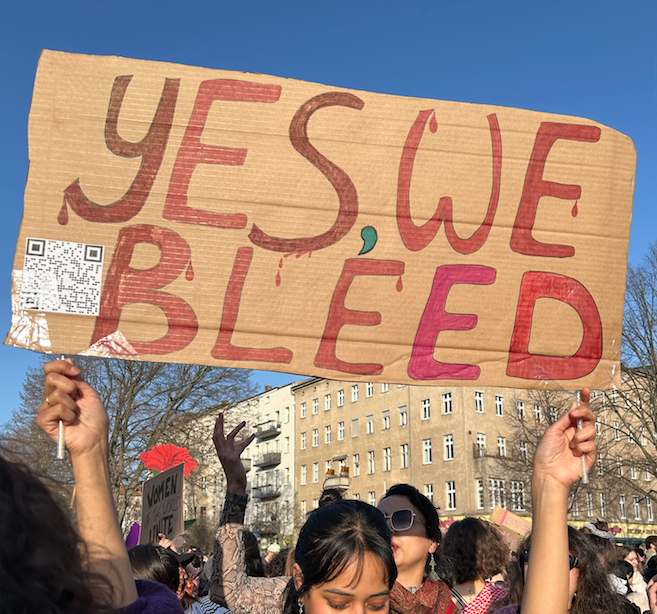
Our association is called YesWeBleed, not YesWe“menstruate”,  because everybody bleeds, and every person on this planet exists thanks to someone who has experienced menstruation. Menstrual and reproductive health concerns everyone, and equitable access to that care must be recognized as a fundamental human right.


3. Respect & Safety in Our Spaces

We commit to creating inclusive, brave spaces rooted in mutual respect and care. Therefore:

We do not tolerate:

Racism, anti-Blackness, colorism, or xenophobia

Transphobia, homophobia, or queerphobia

Sexism, misogyny, or misogynoir

Ableism or classism

Body shaming or reproductive shaming

Derogatory language, slurs, or harassment of any kind

We ask all participants to:

Reflect on their own position and avoid reproducing oppression while sharing.

Center care, listening, and openness in all interactions.

Respect people’s pronouns, names, and identities without question or debate.

Speak from personal experience, and avoid making assumptions or generalizations about others.

Step up or step back, depending on how much space you’re taking in group discussions.


4. Allyship & Accountability

Allies are welcome and essential, but must come with a willingness to listen, learn, and not center themselves.

Our work is rooted in collective care and collective liberation. When harm occurs, we respond with care, accountability, and the opportunity for repair, but never at the expense of the safety of marginalized participants.


5. Ongoing Reflection

These guidelines are living. We are open to feedback and will continue to evolve them collectively, in the spirit of care, learning, and justice.

By joining us, attending our events, or engaging with us on any of our platforms, you acknowledge and agree to uphold these principles and community standards.
Are all our events about menstruation?

Are All Our Events About Menstruation?

No.
Only some of our events focus directly on the physical experience of menstruating.

  1. At YesWeBleed, our work centers around everyone who has, had, or will have a menstrual cycle, not just those actively menstruating. Menstruation is one part of a much wider and more complex continuum of bodily, emotional, and social experiences. Focusing only on periods would limit the depth and scope of our work.
  2. Menstrual health should be treated as a core part of overall physical and mental well-being, not as something separate, shameful, or unimportant. Menstrual justice is part of social justice:  ensuring fair, equitable treatment of people who menstruate is a matter of human rights and equality. It means breaking down the systemic inequalities and stigma that make menstruation a source of disadvantage for many.
  3. Our work and events are grounded in this broader framework. That’s why we don’t only talk about menstruation, we address the full spectrum of experiences and injustices connected to the menstrual cycle.


Menstrual Health Is More Than Just Periods

The injustices linked to the menstrual cycle go far beyond period poverty or period pain.
They do not begin at menarche (the first period), nor do they end at menopause. These issues are part of much broader systemic injustices—rooted in racism, ableism, transphobia, fatphobia, classism, and the long-standing neglect of reproductive and hormonal health.

We are actively working against a system that fails to acknowledge or meet the needs of people with menstrual cycles. To challenge that, we take an intersectional approach—recognizing that the menstrual experience is shaped by many overlapping identities and realities.


Health Is Political, Care Is Collective

People who menstruate cannot—and should not—be reduced to their cycle. Their physical, mental, emotional, and social well-being are all interconnected. That’s why our events reflect a holistic approach to care, grounded in an intersectional and decolonial lens.

Our programming spans a wide range of themes, all rooted in the pursuit of menstrual justice and collective healing. Some of the events you might find at YesWeBleed include:

  • Workshops on menstrual and hormonal health, rooted in culturally inclusive, community-centered knowledge
  • Advocacy and educational sessions focused on menstrual justice, policy change, and systemic equity
  • Body movement and somatic practices, helping participants reconnect with their bodies in safe and affirming ways
  • Art therapy and creative expression spaces, using artistic practices as a way to process, heal, and speak out
  • Mental health-centered events, exploring topics like shame, burnout, and emotional resilience
  • Collective care and rest spaces, offering time and tools for community healing, reflection, and mutual support

Even when an event doesn’t directly mention menstruation, it is still deeply connected to the lived realities of those with menstrual cycles. 

This is what we mean when we say:
Menstrual health is health. Menstrual justice is social justice.


Menstrual Justice for Everyone

Some of our events are specifically created for people who do not and will never experience a menstrual cycle.
Why? Because menstrual justice is everyone’s responsibility. We believe that creating a society that respects, understands, and supports menstrual experiences requires collective awareness and collective action.

Let’s not forget: the menstrual cycle makes human life possible. Nearly half of humanity will experience it, yet it remains misunderstood, stigmatized, and silenced.

Everyone—whether they menstruate or not—has a role to play in dismantling the systems that uphold menstrual injustice.

If you have any questions about our events, our mission, or whether a particular event is for you, don’t hesitate to reach out:
📩 yeswebleed@gmail.com

Why Our Events Prioritize BIPoC Participation

At YesWeBleed, we center BIPoC voices in our work toward menstrual equity and justice.
BIPoC stands for Black, Indigenous, and People of Color: communities that have historically and systemically been excluded, silenced, or overlooked in mainstream conversations around health, including menstrual health.


Why Prioritize BIPoC Participation?

BIPoC individuals often face compounded layers of discrimination based on race, gender, class, and colonial legacies. These overlapping injustices mean that BIPoC menstrual experiences are not only underrepresented, they are often actively ignored, erased, or pathologized.

For example, medical systems tend to dismiss the pain of Black menstruators, Indigenous healing knowledge is often marginalized, and many non-Western perspectives on menstruation are deemed “unscientific” or “taboo” in dominant discourse.

The world of menstrual health innovation, research, and femtech is still predominantly white-led, often failing to reflect or meet the specific needs of BIPoC communities. From product design to health education to data collection, BIPoC bodies and experiences remain invisible or underserved.

That’s why prioritizing BIPoC participation is not about exclusion, it’s about repair, equity, and justice. It’s about creating space for those most impacted by systemic inequalities to be heard, seen, and centered in the movement for menstrual justice.

Our Approach: Intersectional, Decolonial, and Community-Centered

We view menstrual health through an intersectional lens, acknowledging how race, class, gender, disability, and more intersect to shape people’s access to care, resources, and respect.

We are also committed to a decolonial approach, meaning we actively seek to:

  • Uplift non-Western narratives and knowledge systems
  • Challenge Eurocentric norms in health discourse
  • Celebrate the wisdom and practices of global majority communities

This is not just about representation. It’s about transforming the structures that continue to marginalize.


Can I Join If I’m Not BIPoC?

Absolutely.
Many of our participants and community members do not identify as BIPoC. We believe that true systemic change requires advocates from all backgrounds.

However, in spaces where BIPoC voices have historically been silenced, it is essential to rebalance and make intentional space. Prioritizing BIPoC does not mean others are excluded, it means we are actively building inclusive, safer spaces where those most impacted can lead, speak, and be prioritized.

When an event fills up quickly, especially those with BIPoC priority, we do our best to host it again to ensure more people get the chance to participate.


Joining Us

If you’re interested in attending one of our events, we invite you to read our community guidelines first.
We’re cultivating a space rooted in respect, listening, and mutual care.

One of our core values: Never assume—always ask.
If you have any questions, or if you’re unsure about anything, don’t hesitate to reach out:
📩 yeswebleed@gmail.com