1. Who We Welcome
Our spaces are open to:
Everyone who has, had, or will have a menstrual cycle.
Trans, non-binary, and gender-fluid people, as well as their allies.
All people committed to inclusive, respectful, and compassionate engagement.
We center the experiences and voices of Black, Indigenous, and People of Color (BIPoC), acknowledging their historical and ongoing exclusion from conversations and research about menstrual and reproductive health. If you want to read more about this, click here.
Some of our events may be held in non-mixed or restricted-mixity spaces to create safer and more intentional environments for specific communities. When this is the case, it will always be clearly stated in the event description, so participants can make informed decisions about attending.
2. Our Approach
We operate from a:
Non-essentialist perspective: We do not reduce menstruation or reproductive experiences to cis womanhood.
Decolonial lens: We actively resist systems of domination, colonial frameworks, and all forms of systemic oppression.
Holistic understanding: We recognize that menstruation is just one aspect of the menstrual cycle, and the menstrual cycle itself is part of a broader continuum that may include menarche, pregnancy, miscarriage, abortion, premenopause, menopause, and more — all of which are valid experiences that deserve care, dignity, and support.
We also affirm that menstrual and reproductive health are integral to overall health. Every effort toward menstrual and reproductive justice is an effort toward broader health equity.
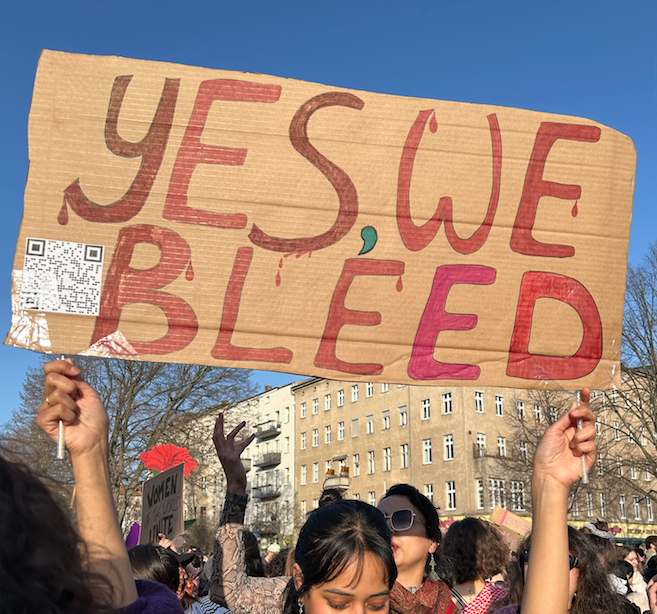
Our association is called YesWeBleed, not YesWe“menstruate”, because everybody bleeds, and every person on this planet exists thanks to someone who has experienced menstruation. Menstrual and reproductive health concerns everyone, and equitable access to that care must be recognized as a fundamental human right.
3. Respect & Safety in Our Spaces
We commit to creating inclusive, brave spaces rooted in mutual respect and care. Therefore:
We do not tolerate:
Racism, anti-Blackness, colorism, or xenophobia
Transphobia, homophobia, or queerphobia
Sexism, misogyny, or misogynoir
Ableism or classism
Body shaming or reproductive shaming
Derogatory language, slurs, or harassment of any kind
We ask all participants to:
Reflect on their own position and avoid reproducing oppression while sharing.
Center care, listening, and openness in all interactions.
Respect people’s pronouns, names, and identities without question or debate.
Speak from personal experience, and avoid making assumptions or generalizations about others.
Step up or step back, depending on how much space you’re taking in group discussions.
4. Allyship & Accountability
Allies are welcome and essential, but must come with a willingness to listen, learn, and not center themselves.
Our work is rooted in collective care and collective liberation. When harm occurs, we respond with care, accountability, and the opportunity for repair, but never at the expense of the safety of marginalized participants.
5. Ongoing Reflection
These guidelines are living. We are open to feedback and will continue to evolve them collectively, in the spirit of care, learning, and justice.
By joining us, attending our events, or engaging with us on any of our platforms, you acknowledge and agree to uphold these principles and community standards.